
Death Due to Heart Attack at Workplace Under ESIC
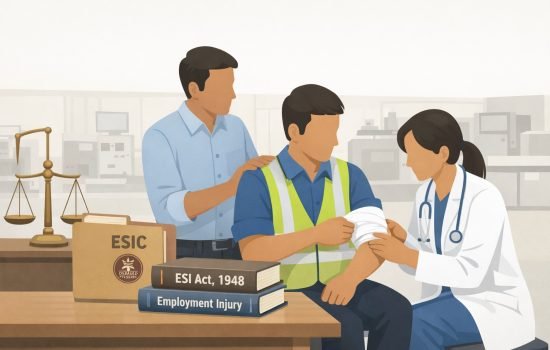
Introduction: When Does a Heart attack at workplace Become an “Employment Injury”?
When an employee dies due to a heart attack at the workplace, the first reaction is often emotional and understandable. Many people feel that if the collapse happened while the person was working, the death must automatically be work-related. However, Indian courts cannot decide such cases based only on emotion or sympathy. They are required to examine whether there is a legal link between the employment and the death, not just a physical link with the workplace.
This means the Court must ask deeper questions. Did the employee die merely at the workplace, or did the nature, timing, or conditions of work play a role in the death? This difference is crucial under labour and social security laws.
The Bombay High Court judgment in Bhagyashree Bharguram Mahadik vs Employees’ State Insurance Corporation is an important ruling on this issue. The Court clearly explained when a heart-related death at the workplace can be treated as an employment injury under the Employees’ State Insurance Act, 1948. The judgment carefully balanced medical facts with legal protections meant for workers and their families.
Why Heart Attack at Work Cases Create Legal Uncertainty
Heart-attack-at-work cases create legal confusion because they do not fit neatly into the usual idea of a workplace accident. When an employee slips, falls, or is injured by a machine, the cause is visible and easy to connect to the job. A heart attack, however, often happens without warning. It may be linked to age, lifestyle habits, diabetes, blood pressure, or long-standing heart problems. In many cases, there is no single external incident to clearly point to.
Because of this, courts cannot rely only on medical labels like “natural death.” They have to look deeper and ask an important question: did the work play any role at all? Long working hours, physical strain, heat, mental pressure, or sudden stress may not cause heart disease by themselves, but they can trigger or worsen a cardiac event. The legal challenge is to decide whether the death was only a coincidence of place, or whether work conditions contributed to it. The Bhagyashree Mahadik case directly addresses this difficult line.
Read: False POSH Complaint – Anita Suresh Delhi High Court Judgment
Facts of the Case: What Actually Happened
Bharguram Mahadik was working as a Fitter with Dhanwantari Engineers Pvt. Ltd. and was covered under the ESI insurance scheme. He earned a modest salary, like many industrial workers who depend fully on their daily employment for family support.
On 27 March 2012, he reported to work at around 8:30 in the morning. Shortly after starting work, around 8:45 a.m., he complained of chest pain. His co-workers immediately helped him and took him to a resting area inside the factory so that he could recover. Unfortunately, his condition continued to worsen. Around 10:45 a.m., he was rushed to NMMC General Hospital at Vashi.
The doctors declared him “brought dead” on arrival. The medical records mentioned Acute Myocardial Infarction (heart attack) as the cause of death. At the time of his death, Bharguram Mahadik was about 50 years old.
The Claim for Dependents’ Benefit
After the employee’s death, the employer took the required step of submitting a Dependants’ Benefit claim under the Employees’ State Insurance Act on 11 April 2012. The claim was filed with all relevant documents, including proof of employment and medical records relating to the death. This benefit was meant to provide financial support to the family after the loss of the earning member.
However, on 14 May 2012, ESIC rejected the claim. The Corporation stated that the employee’s death was due to natural causes, that there was no stress or strain of work, and therefore the death could not be treated as an employment injury under the law. This decision had a serious impact on the widow, as she was denied statutory support even though her husband had collapsed and died during working hours inside the factory premises. The rejection forced her to seek legal relief to protect her rightful claim under the ESI Act.
Read: Step-by-Step Guide for Handling ESIC Accidents in India
How This Case Came to Be Listed Before the High Court
Ordinarily, disputes under the ESI Act are required to be adjudicated by the Employees’ Insurance Court under Section 75. ESIC raised this very objection before the High Court, arguing that the widow had an alternative statutory remedy.
Despite this, the petitioner approached the Bombay High Court directly by filing a writ petition.
The High Court admitted the petition and made the Rule returnable forthwith, indicating that the Court found the matter fit for immediate examination. This was primarily because:
• the facts were undisputed (employment, time of death, place of death, cause of death),
• the rejection was based on a mechanical and cryptic medical opinion,
• the dispute involved interpretation of Section 51A (statutory presumption), and
• the issue raised a pure question of law, rather than contested factual evidence.
The Court therefore exercised its constitutional writ jurisdiction, instead of relegating the widow to a prolonged and burdensome trial before the Insurance Court.
This procedural aspect is important: it demonstrates that where statutory benefits are denied through patent illegality or misapplication of law, High Courts may intervene directly despite alternate remedies.
Core Legal Issue Before the Court
The central question was:
Whether the death of an insured employee due to a heart attack at the workplace constitutes an “employment injury” under the Employees’ State Insurance Act, 1948.
The main legal question before the Court was simple but important. The Court had to decide whether the death of an employee, caused by a heart attack while he was at work, could legally be treated as an “employment injury” under the Employees’ State Insurance Act, 1948. This decision was crucial because dependants’ benefits are payable only when death results from an employment injury.
This required interpretation of:
• Section 2(8) – Employment Injury
• Section 51A – Presumption as to accidents arising in the course of employment
• Section 52 – Dependants’ Benefit
To answer this, the Court carefully examined three key sections of the law. Section 2(8) explains what an employment injury is and requires a link between work and injury. Section 51A creates a legal presumption that if an incident happens during employment, it is assumed to be work-related unless proved otherwise. Section 52 connects this finding to the payment of benefits to the family. The case required the Court to balance medical facts with legal protections meant for workers.
Arguments Advanced by the Widow (Petitioner)
The petitioner contended that:
The deceased reported for duty and collapsed during working hours inside the factory premises.
Under Section 51A, once it is shown that the incident occurred in the course of employment, the law presumes that it arose out of employment.
The ESI Act is a beneficial social security legislation and must be interpreted liberally.
ESIC did not establish any pre-existing heart disease.
Even a natural medical event can become an employment injury if employment contributes to or accelerates the death.
Arguments Advanced by ESIC
ESIC opposed the petition on the following grounds:
A heart attack is a natural cause of death, not an accident.
There was no evidence of unusual stress or strain of work.
The opinion of the Senior State Medical Commissioner described the death as natural.
The presumption under Section 51A is rebuttable.
The petitioner should have approached the Employees’ Insurance Court instead of the High Court.
Judicial Interpretation of “Employment Injury”
Section 2(8): Employment Injury
The Court reiterated that an employment injury must:
• arise out of employment, and
• occur in the course of employment.
Both elements must coexist, subject to statutory presumptions.
Section 51A: Presumption of Causation
Section 51A provides that:
• when an accident occurs in the course of employment,
• it shall be presumed to have arisen out of employment,
• unless evidence to the contrary is produced.
The Court clarified that once course of employment is established, the burden shifts to ESIC to rebut the presumption.
Why the Court Rejected ESIC’s Defence
The Court rejected ESIC’s defence mainly because it was not supported by proper evidence. ESIC argued that the employee’s death was due to natural causes, but it failed to prove that the employee had any previous heart-related illness. The Court clearly noted that ESIC never claimed, nor showed through records, that the deceased was already suffering from heart disease before reporting for duty. This point was important because if a serious pre-existing condition had been established, ESIC could have argued that the death had no link with work.
Since no such medical history was placed on record, the Court found it unsafe to treat the death as purely natural. In the absence of proof of an existing heart ailment, the possibility that work conditions or work timing contributed to the cardiac event could not be ruled out. This lack of evidence seriously weakened ESIC’s stand and strengthened the widow’s claim under the ESI Act.
Medical Opinion Was Inadequate
The Court found the medical opinion relied upon by ESIC to be legally inadequate. It merely labelled the death as “natural” and stated, without explanation, that there was no involvement of stress or strain of work. Such a bare conclusion, the Court observed, does not amount to evidence. The opinion did not examine the employee’s working conditions, the timing of the collapse, the nature of duties performed, or whether exertion or stress could have acted as a trigger.
Because Section 51A creates a statutory presumption in favour of the employee once death occurs during employment, that presumption can be displaced only by reasoned, substantive medical analysis, not by a one-line assertion.
Presumption Was Not Rebutted
Under Section 51A of the ESI Act, once it is established that an incident occurred in the course of employment, the law automatically presumes that it also arose out of employment, unless proved otherwise. In this case, the foundational facts were undisputed: the employee had reported for duty, suffered a collapse during working hours, and died within the factory premises. These facts were sufficient to trigger the statutory presumption. The legal burden then shifted to ESIC to rebut this presumption with clear, cogent, and credible evidence.
However, ESIC relied only on a vague medical remark describing the death as “natural,” without any supporting reasoning or factual analysis. In the absence of substantive evidence breaking the work–death link, the presumption remained intact and operative in law.
Application of Notional Extension Theory
The Court applied the Notional Extension Theory to recognise that employment is not confined to the exact spot where work is performed. In industrial settings, employment extends to all areas that are reasonably connected with work, including rest rooms and common spaces within the factory premises. An employee may need to rest, move, or take brief breaks as part of normal work life, and these activities remain within the employment sphere.
In this case, the employee collapsed in the factory rest area after reporting for duty. The Court held that such a location falls within the extended boundary of employment, and therefore the death occurred during employment for the purpose of ESIC liability.
Final Decision of the Court :
1. Death Happened During Work
The Bombay High Court found that the employee collapsed and died while on duty and within the factory premises. This satisfied the first legal requirement for an employment injury because the incident happened in the course of employment.
2. Section 51A Presumption Applied
Under Section 51A of the ESI Act, when an accident (or incident like this) happens during work, the law presumes it also arose out of employment. The Court said this presumption applied since the collapse happened during working hours.
3. ESIC Did Not Disprove the Presumption
ESIC failed to produce strong and reasoned evidence to show that the death did not arise because of employment. The one-line medical opinion calling it a “natural death” was not enough to overturn the legal presumption.
4. Rejection Letter Set Aside
The Court cancelled ESIC’s rejection letter dated 14 May 2012.
5. Direction to Pay Benefits
ESIC was ordered to settle the claim and pay the dependants’ benefit within four weeks.
Legal Principle Established
The main legal message from this judgment is simple and practical. A heart attack at the workplace is not automatically excluded from ESIC benefits just because it is called a “natural death.” When an employee collapses and dies while on duty, the law first assumes that the death is work-related. This assumption applies unless ESIC can clearly prove otherwise with proper evidence.
At the same time, the Court made it clear that not every heart attack at work will qualify for compensation. Each case depends on facts. What the Court strongly rejected was the habit of denying claims mechanically, only by saying “it was a natural death,” without examining how and when the death happened.
In simple terms, the Court said:
look at the connection between work and death, not just the medical label. If ESIC cannot break that connection with solid proof, the benefit must go to the employee’s family.
Conclusion
The Bhagyashree Mahadik judgment clearly reminds us why social security laws exist. These laws are meant to protect workers and their families during the most difficult times. The Court stressed that statutory presumptions are created to help employees, not to be ignored or rejected with short, unsupported opinions. Authorities cannot deny benefits by using technical words like “natural death” without proper reasoning.
At its heart, the judgment delivers a simple message: when an employee dies during work, the law should focus on fairness and protection, not on finding quick reasons to deny support. Where work and death meet, the law must favour human welfare over narrow technicalities.