
Multiple Unions in One Factory: How Should HR Handle Competing Unions?
A plant HR manager once told me, half-joking and half-serious, “Sir, we don’t have one union problem here, we have three.” Two unions were affiliated to different national federations, and a third had come up locally after some contract workers felt neither of the existing unions was speaking for them. Every festival advance, every transfer order, every canteen menu change was suddenly a matter of competing charters of demands.
If you have worked in a unionised Indian factory for more than a few years, this situation is not unusual at all. Multiple unions in one factory is a reality in a good number of manufacturing units, especially where the workforce is large, where there has been a history of splits, or where contract and permanent workmen have different interests. HR ends up in the middle, trying to run production, keep discipline, and still be seen as fair by everyone wearing a union badge.
This article looks at how HR and IR teams can actually handle multiple unions on the ground — recognition, negotiation, communication, and the everyday balancing act — without pretending there is one neat formula that solves it.
Read: Employee Disciplinary Action in India: Complete HR Guide
Why Do Multiple Unions Come Up in the Same Factory?
Before getting into “what HR should do,” it helps to understand why this situation develops in the first place. It rarely happens overnight.
Internal politics and leadership disputes. Very often, a second union is born out of a split in the first one. Someone loses an election, feels sidelined, or disagrees with the direction of the existing union leadership, and decides to register a new union with a fresh set of office bearers.
Different worker categories with different interests. Permanent workmen, contract workmen, and sometimes even trainees or apprentices may feel their concerns are not identical. A union that represents permanent employees well may not automatically be trusted by contract workers, so a separate body forms.
Federation rivalry. In many industrial belts, national or state-level federations compete for membership across factories. A federation that is strong in a nearby unit may try to establish a presence in yours, sometimes with the encouragement of a section of the workforce.
Perceived weak representation. If workers feel the existing union has become too close to management, or has stopped delivering results on genuine grievances, a rival union naturally gets an opening.
None of this is something HR can fully prevent. What HR can control is how the organisation responds once multiple unions are a reality.
The Core HR Challenge: Recognition, Not Just Coexistence
The first practical question every HR head asks is this — do we recognise all the unions, or only one, for the purpose of negotiation?
Under Indian labour law, there is no blanket central requirement that forces an employer to recognise every registered trade union for collective bargaining. Recognition practices vary by state, by industry, and by whether the state has its own recognition legislation (some states have specific provisions on recognition of a representative union; others do not, and recognition is largely a matter of employer policy and practice). This is a point where the exact legal position should be verified against the applicable state law, any certified standing orders, and company recognition policy before HR commits to a stated position in writing.
What is common in practice, regardless of the exact legal route, is this:
- Management usually prefers to negotiate wage settlements and major issues with one union that can demonstrate majority membership, rather than negotiating separately with every union that exists on paper.
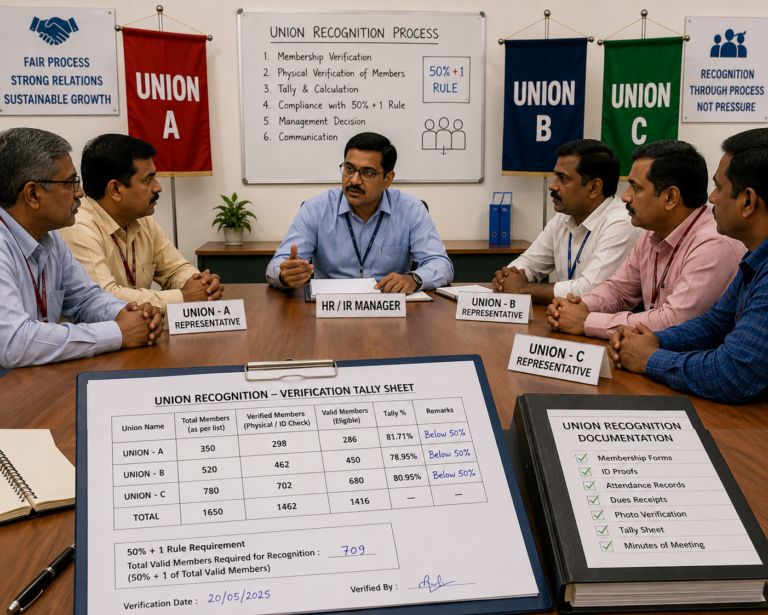
- Membership verification — through methods like secret ballot, membership records, or check-off data — is often used to establish which union genuinely represents the majority of workmen.
- Even where one union is treated as the “recognised” or “majority” union for negotiation purposes, other unions continue to exist, and their office bearers still have a right to represent their own members on individual grievances, subject to the applicable law and standing orders.
HR’s job here is not to decide who is “right.” It is to have a clear, defensible, and consistently applied basis for who the company negotiates the charter of demands with, and to document that basis properly.
Read:How to Handle Habitual Late Coming Employees in India (HR Guide)
What HR Should Do First When a Second (or Third) Union Appears
Step 1: Verify Registration and Do Not React Emotionally
When a new union registers, plant HR often gets nervous, sometimes reacting as if this is automatically a crisis. It is not. The first step is simply to confirm the union’s registration status and note its office bearers and stated membership claims. There is no need to issue any statement or take a defensive posture at this stage.
Step 2: Keep Communication Channels Open with All Unions
This is where a lot of HR teams go wrong. Once a rival union appears, some HR managers start avoiding the new union entirely, assuming that talking to them will “legitimise” them or upset the existing union. In practice, this often backfires — the new union feels shut out and becomes more aggressive to prove its relevance.
A more workable approach: acknowledge the new union’s existence, meet their office bearers on individual matters concerning their own members (like a disciplinary case or a personal grievance), but keep the formal charter-of-demands negotiation restricted to whichever union meets the company’s recognition criteria.
Step 3: Establish (or Revisit) a Written Recognition Policy
If your factory does not already have a documented policy on how a union is recognised for negotiation purposes — membership threshold, verification method, frequency of re-verification — this is the time to get one in place, in consultation with competent legal or IR counsel. Without this, every negotiation season becomes a fresh argument about legitimacy.
Step 4: Brief HODs and Supervisors Clearly
Supervisors on the shop floor are often the first to feel the pressure of union rivalry — workers testing which union’s instructions they will follow, minor issues being escalated by rival unions to score points against each other. HODs need a simple, consistent line: production instructions and discipline are managed through the normal HR/IR process, not through whichever union shouts louder that week.
What HR Should Avoid
- Do not play favourites informally. Even if one union has historically been easier to deal with, visibly favouring them (extra facilities, faster grievance redressal, informal access to management) will be noticed and will fuel rivalry.
- Do not let a supervisor unilaterally decide which union “wins” a shop-floor dispute. That decision should go through HR/IR, not be settled informally on the floor.
- Do not ignore a union simply because its membership is smaller. A minority union can still create disruption, and individual members are still entitled to fair treatment on personal matters.
- Do not negotiate the same issue separately and differently with two unions at the same time. This creates a bidding war and destroys the credibility of any settlement reached.
- Do not make public statements that appear to take sides. Anything HR says informally travels fast on the shop floor and gets repeated with additions.
Read: Domestic Enquiry in India: Step-by-Step HR Guide for Beginners (2026)
Documentation HR Should Maintain
Good documentation is what protects the company if a recognition dispute or an unfair labour practice complaint comes up later.
- Copies of registration certificates and any communication received from each union
- Records of membership verification exercises, if conducted (ballot results, check-off data, or membership forms, depending on the method used)
- Minutes of meetings held with each union, including individual grievance discussions
- The company’s written recognition policy and any revisions made to it over time
- Correspondence relating to charter of demands, notices, and settlements signed
- Records of any incidents of inter-union friction on the shop floor, especially where discipline action was taken
If a matter ever reaches a labour court, conciliation officer, or industrial tribunal, this documentation is what demonstrates that the company acted consistently and did not arbitrarily favour or victimise any union — a principle closely tied to natural justice in industrial relations matters.
What Can Go Wrong
Inter-union rivalry, if not managed carefully, tends to show up in fairly predictable ways:
- Minor floor-level disagreements (seating, shift allocation, overtime distribution) get escalated deliberately to demonstrate which union is “more active.”
- Genuine worker grievances get delayed because they become tools in the rivalry rather than issues to be resolved.
- Supervisors get caught between two sets of informal pressure and start avoiding decisions altogether, which slows down day-to-day operations.
- In more serious cases, rivalry spills into confrontation between groups of workers themselves, which becomes a discipline and safety issue, not just an IR issue.
- Negotiations get prolonged because a settlement reached with one union is publicly criticised by the other, creating pressure to reopen talks.
HR that has seen this play out before knows the value of catching the early signs — repeated minor complaints from the same group, sudden change in attendance patterns during a particular union’s meetings, or supervisors reporting that workers are “checking” with a union representative before responding to routine instructions.
Read: Contract Workers Union & Charter of Demands: Legal Duties of PE & Contractor in India
Practical Examples
Example 1 — Manufacturing/Plant: A components manufacturing unit near an industrial estate had one established union for over a decade. A group of contract workers, unhappy that the union’s charter of demands rarely addressed contract labour issues, formed a separate union. HR’s approach was to continue formal wage negotiations with the recognised union (which met the membership threshold under company policy) while opening a separate, informal channel to hear out contract labour concerns directly, eventually folding some of those concerns into the standing orders review. This reduced the appeal of the new union without denying it a voice.
Example 2 — Corporate/Office Environment: Though less common, some larger corporate back-offices with unionised support staff (housekeeping, security, drivers) have seen similar rivalry when a service provider’s union and an in-house employee association both claim to represent the same category of staff. HR handled this by clarifying, in writing, which category of workers fell under which employment relationship, since negotiating with the wrong body for the wrong category of staff can create confusion about who the actual employer is for those workers.
Example 3 — Unionised Workplace with Federation Rivalry: In one auto-ancillary unit, two unions affiliated with rival federations both claimed majority support ahead of a wage settlement. Instead of accepting either claim at face value, the company, in consultation with the conciliation officer, agreed to a secret ballot process to verify actual membership strength before entering into formal negotiations. This avoided a prolonged dispute over legitimacy and gave both sides a result they could not easily contest.
Example 4 — Manager and Supervisor Situation: A production HOD, frustrated with repeated stoppages, started informally telling workers that “this union” was easier to deal with than “that union.” Word got back to HR within days. HR had to step in, remind the HOD that such comments were not to be made, and reinforce that all union-related matters go through the IR desk, not informal shop-floor comments. This is a common trap — well-meaning HODs, out of sheer operational pressure, end up saying something that later gets quoted back during a dispute.
How HR Should Communicate Through All This
Tone matters as much as content when there is more than one union in the picture. A few things that experienced IR practitioners tend to stick to:
- Keep communication factual and even-handed, whether it is a notice, a circular, or a verbal update during a meeting.
- Avoid comparing unions to each other in any written or verbal communication.
- When a settlement is reached with the recognised union, communicate it clearly to the entire workforce, not just union members, so there is no room for a rival union to claim the information was hidden or selective.
- Where a grievance genuinely belongs to a minority union’s member, handle it on merits, the same way it would be handled for anyone else, regardless of which union the person is affiliated to.
Read:Can a Probationary Employee Terminate Without Notice Period?
Practical HR Takeaway
Multiple unions in one factory is not, by itself, a sign that something has gone wrong with your industrial relations. It often reflects genuine differences in worker interests, or simply the natural life cycle of union politics. What actually determines whether it becomes a manageable situation or a running problem is how consistently HR applies its recognition criteria, how transparently it documents decisions, and how disciplined supervisors and HODs are about not getting pulled into informal favouritism. A written recognition policy, verified through a defensible method, backed by proper records, and applied the same way every negotiation cycle, is what keeps multiple unions from turning into a permanent source of shop-floor friction.
Frequently Asked Questions
1.Can a factory legally have more than one trade union? Yes. Workers have the right to form and join trade unions, and there is no bar on multiple unions existing in the same establishment. Whether the employer is required to negotiate with all of them, or only a recognised majority union, depends on applicable state law, any recognition legislation in force in that state, and company policy — this should be confirmed with competent legal advice for the specific state and industry.
2.Is HR required to recognise every union that registers? Not automatically. Recognition for the purpose of collective bargaining is generally based on demonstrated majority membership, verified through an agreed method, rather than on registration alone. The exact process should follow the company’s recognition policy and applicable state provisions, if any.
3.Can HR refuse to negotiate the charter of demands with a minority union? In most practical setups, formal charter-of-demands negotiation is conducted with the union that meets the recognition criteria, while individual grievances of members of other unions are still addressed. Refusing to engage with a minority union entirely on individual matters can create risk and should be avoided; refusing to conduct the main wage negotiation with a non-recognised union is a different matter and is commonly accepted practice, subject to legal confirmation.
4.What is the safest way to verify which union has majority support? Common methods include secret ballot, verified membership records, or a check-off system where union subscription is deducted through payroll with employee consent. The appropriate method should be decided in consultation with IR/legal counsel and, where relevant, the conciliation officer.
5.How should HR handle a wage settlement when two unions both claim majority? It is advisable to resolve the majority question first, through a verifiable method, before proceeding with formal negotiation, rather than negotiating in parallel with both unions on the same charter of demands.
6.Can inter-union rivalry be treated as a disciplinary issue? Rivalry itself is not misconduct. However, specific acts arising from it — intimidation, obstruction of work, threats, or physical confrontation — can attract disciplinary action under the company’s standing orders or service rules, based on the facts of each case.
7.Should supervisors be involved in deciding which union a worker should approach? No. Supervisors should stay out of union-related decisions entirely and route any union-related matter to HR/IR. Their informal involvement, even with good intentions, tends to be perceived as favouritism.
8.Does having multiple unions increase the risk of production disruption? It can, particularly during charter of demands season or when rivalry is at a peak, but this risk is manageable with a clear recognition policy, consistent communication, and early attention to shop-floor friction before it escalates.