
Table of Contents
ToggleCase Law : Kerala High Court on WhatsApp Messages, Workplace Safety & Employee Rights
Insights of WhatsApp disciplinary case Kerala High Court
What Every HR Professional and Young Lawyer Should Learn from the Sujith T.V. vs FACT Ltd. Judgment
Industrial workplaces, especially chemical and manufacturing units, often deal with sensitive safety issues. This judgment from the Kerala High Court offers a valuable lesson on how employers should handle employee communication, disciplinary procedures, and safety protocols. It also highlights the importance of respecting an employee’s freedom of speech when the concern raised relates to workplace safety.
Read: Vinod Narayan Kachave vs The Presiding Officer (ICC) & Another – POSH Case Law
1. Case Snapshot
Court: High Court of Kerala, Ernakulam
Judge: Justice Sathish Ninan
Case: WP(C) No. 13438 of 2021
Date: 18 June 2024
Petitioner: Sujith T.V., Technician (Process), FACT R&D Centre
Respondents: FACT Ltd. and senior officials
2. What Was the Case About?
The petitioner, an employee of FACT (Fertilisers and Chemicals Travancore Ltd.), challenged two things:
His suspension
The punishment of “warning” issued in a disciplinary proceeding
The company accused him of:
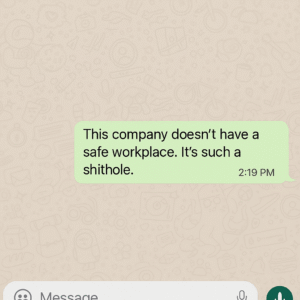
Posting messages in a private WhatsApp group that allegedly hurt FACT’s reputation.
Entering the ammonia-handling section of another unit without permission.
The Court had to decide whether these accusations were valid and whether the company followed proper procedure.
3. The Two Charges Explained
Charge 1 – WhatsApp Messages
FACT claimed the petitioner posted messages that:
Created fear about workplace safety
Gave the impression that the company’s ammonia-handling system was unsafe
Could instigate co-workers to “fight against the company”
Damaged the company’s reputation
However, the petitioner said the messages were simply safety concerns shared privately among technicians.
Charge 2 – Unauthorized Entry
The company also alleged that the petitioner entered the ammonia-handling area of the Ambalamedu division without permission, even though he worked at the R&D Centre in Udyogamandal.
He admitted entering the area but said it was without any harmful intention.
Read; Procedure to Follow in Case of Death in Factories:
4. Punishment Awarded by the Company
FACT issued a “WARNING” without holding a formal enquiry.
Important Points:
The company treated the petitioner’s apology as an admission of guilt for both charges, even though he denied Charge 1.
The company did not verify whether the WhatsApp messages were actually harmful before issuing punishment. There was no review of context, intent, or the private nature of the group.
No hearing on punishment was given, but the company argued that a warning is the lowest penalty, so a hearing was not needed.
5. What the Court Found
Justice Sathish Ninan examined both charges separately.
A. Was the Writ Petition Delayed?
The company said the case was filed after two years and should be dismissed.
The Court rejected this because:
The case involved fundamental rights
The petition had already been admitted in 2021
B. Charge 1 – WhatsApp Safety Messages
The Court carefully reviewed the messages and observed:
They did not insult or defame the company
They were not public, only shared in a private group
They were simply safety worries about ammonia handling
Expressing workplace safety concerns is protected under Article 19(1)(a) – Freedom of Speech
Therefore, Charge 1 was invalid.
Also, the apology did not mean he admitted guilt, so an enquiry was mandatory.
Since no enquiry was held, the action was flawed.
C. Charge 2 – Unauthorized Entry
This charge was upheld because:
The petitioner admitted entering the restricted area
The area involves sensitive industrial safety
Admission made a formal enquiry unnecessary
So Charge 2 was valid.
D. Was a Hearing Needed Before Punishment?
No. For minor punishments like “warning”, the law does not require a hearing on penalty.
6. Final Decision of the Court
Charge 1 (WhatsApp): Thrown out
The Court said punishing an employee for voicing safety concerns in a private group violates freedom of speech.Charge 2 (Unauthorized entry): Upheld
The employee admitted it and it was a safety risk.Punishment of “warning”: Allowed to remain, but ONLY because of Charge 2
Suspension and enquiry issues: No interference by the Court.
Read: Job-Hopping Every 2–3 Years: Strength or Risk? A Complete HR Perspective in Today’s Workplace.
7. Key Learnings for HR, Management & Law Students
1. Safety concerns ≠ misconduct
Employees should not be punished simply for raising genuine safety issues.
2. A private conversation is not defamation
WhatsApp messages shared inside a restricted group are not automatically harmful to the company.
3. Apology ≠ Admission
HR must carefully evaluate whether the employee truly admits wrongdoing.
4. Enquiry is mandatory unless the charge is clearly admitted
Here, Charge 1 was denied → enquiry needed.
Charge 2 was admitted → enquiry not required.
5. Minor penalties do not always need a hearing
A “warning” is considered the lightest punishment.
6. Workplace safety rules matter
Unauthorized access to sensitive areas is a legitimate offence.
8. Why This Case Matters
This judgment strikes a healthy balance between:
Employee rights
Industrial safety
Management authority
Fair disciplinary practices
It teaches companies to differentiate between genuine safety communication and misconduct, and reminds employees to follow safety rules even when they mean no harm.