
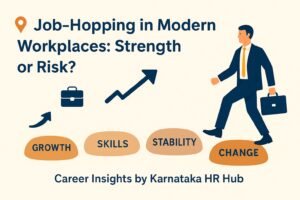
Job-Hopping Every 2–3 Years: Strength or Risk? A Complete HR Perspective in Today’s Workplace.
Introduction
Changing jobs every 2.5 to 3.5 years is now common. Many professionals jump roles for higher salary, better title, flexible work culture, or due to dissatisfaction.
But one important question remains: Is job-hopping helpful or harmful for long-term career success?
From a senior HR perspective, the answer is balanced — job-hopping helps only when done with purpose, not pressure.
Let’s understand this through today’s HR trends, simple explanations, and practical career advice.
Why Job-Hopping Can Be a Strength in Today’s HR Environment
Before judging job-hopping, it’s important to understand what the modern workplace actually demands. Today’s companies value speed, adaptability, and exposure — areas where job-hoppers often perform well.
1. Job-hopping builds adaptability
Modern organizations keep changing — new technologies, new teams, mergers, hybrid work styles.
Employees who worked in multiple setups adapt faster and handle uncertainty better.
2. It provides wider exposure
Every company has different systems, leadership mindsets, and cultures.
Working in varied environments increases your thinking capacity, helps you understand industry best practices, and sharpens your confidence.
3. It keeps your skills updated
Rapid technology upgrades mean skills get outdated fast.
Job-hoppers often learn more tools, processes, and methods because each shift demands new learning.
Where Job-Hopping Becomes a Risk in Current HR Trends
Even though workplaces are changing, hiring expectations remain steady. Companies want dependable, committed professionals who stay long enough to deliver results.
1. High attrition makes employers cautious
Today companies face shortage of stable talent.
When recruiters see short stints repeatedly, they worry:
“Will this person leave us in 18 months?”
2. Leadership roles demand depth, not movement
Handling teams, leading projects, managing crises — these skills come from staying long enough to complete cycles.
Frequent moves prevent this depth.
3. Resume stability still matters
Even in 2025, hiring managers prefer candidates who show consistency.
A scattered job history creates doubts about decision-making maturity.
How Frequent Job Changes Affect Mental Health & Work–Life Balance
Job-hopping often looks attractive — new salary, new environment, new excitement.
But emotionally, it comes with hidden pressure.
Every new job requires fresh adjustment: new colleagues, new expectations, new culture, and a new manager. Constantly proving yourself can create silent stress, anxiety, and loss of confidence.
Work–life balance also gets disturbed.
Most new jobs demand extra effort in the first few months. When someone switches frequently, the “settling phase” becomes constant, leaving little time for rest or family.
Emotionally, frequent movers face:
difficulty fitting in
fear of being judged
pressure to perform immediately
lack of belongingness
emotional exhaustion
Without stability, even good salary cannot give peace.
This is why many say:
“My income doubled… but my peace became half.”
5 Practical Advices to Avoid Unnecessary Job-Hopping
Before changing jobs again, take a step back and evaluate your long-term direction. Career movements should be strategic — not emotional.
1️⃣ Build a long-term career roadmap
Define your next 3–5 years clearly.
Do you want promotion, specialization, higher salary, or a leadership track?
A clear path prevents random shifts.
2️⃣ Explore internal growth before leaving
Many companies offer internal transfers, department changes, or cross-functional learning.
Sometimes growth is available where you already are — but we don’t look.
3️⃣ Stay through complete business cycles
One full project or one appraisal cycle helps you learn real responsibilities.
Depth of experience only comes when you stay long enough to face challenges and solve them.
4️⃣ Focus on skills, not job count
A strong skill carries more value than multiple company names.
Invest in certifications, digital skills, and hands-on experience — these build long-term career power.
5️⃣ Think about resume perception
Your resume should show purpose, not panic.
Before switching, ask yourself:
“Will this move strengthen my story or create confusion?”
Final HR Reflection
Job-hopping is not a mistake — but job-hopping without learning, without patience, and without direction becomes a career trap.
True career success comes from:
adapting with confidence
staying long enough to learn
choosing roles with purpose
maintaining mental and emotional stability
building skills that outlive job titles
Companies value employees who grow with them, not just move between them.
The real secret is balance:
Change jobs for growth, not escape.
Stay long enough to learn, but not long enough to become stagnant.
Build skills that give confidence, not fear.
In the long run, your career is your story — make sure every move strengthens it.